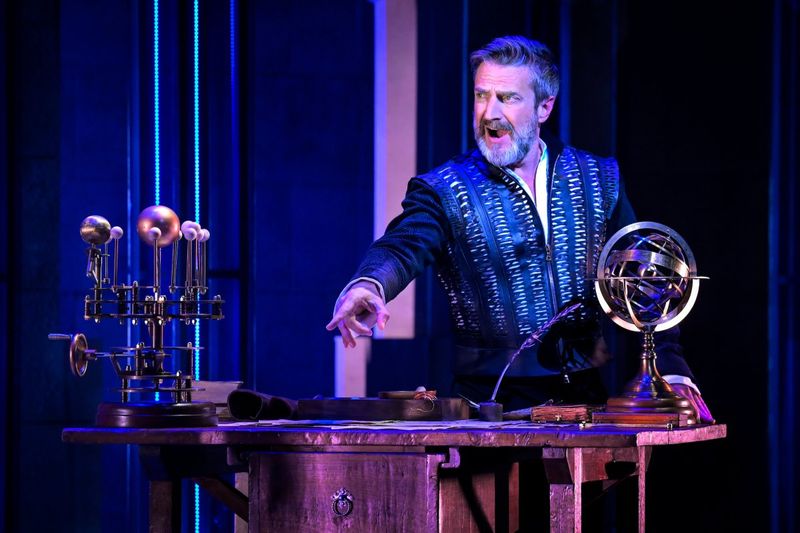
The science behind the story
Galileo’s astronomical observations challenged the accepted picture of the heavens. A telescope made distant objects available to observation, and Galileo’s published findings gave readers new evidence to consider. The musical draws on that moment of discovery, but the stage version focuses on what evidence means to people and institutions.
The conflict is not only about a scientific model. It is also about authority, belief, reputation, and the consequences of publicly defending a conclusion. That combination gives the story dramatic stakes beyond a biography of instruments and observations.
An original score for a historical subject
Galileo features an original score by Zoe Sarnak and Michael Weiner. The production is described as a new musical, not a dramatization with a pre-existing classical score. Its music can translate scientific argument into rhythm, contrast, and emotional momentum while the stage design evokes a historical world.
The creative team includes music supervision and orchestrations by Brian Usifer, with choreography by David Neumann. Lighting, sound, costumes, and projections add distinct ways to represent observation, uncertainty, and power in a live performance.
Listen for the question beneath the spectacle
A useful audience lens is to notice when a character is observing, interpreting, or defending evidence. Scientific discovery involves both looking and explaining; theatrical storytelling can make that process visible through song, movement, and staging.
Read the sourced Galileo history guide, then see tickets and schedule for the Broadway production.
Production schedules and credits can change. Check official sources for current information.